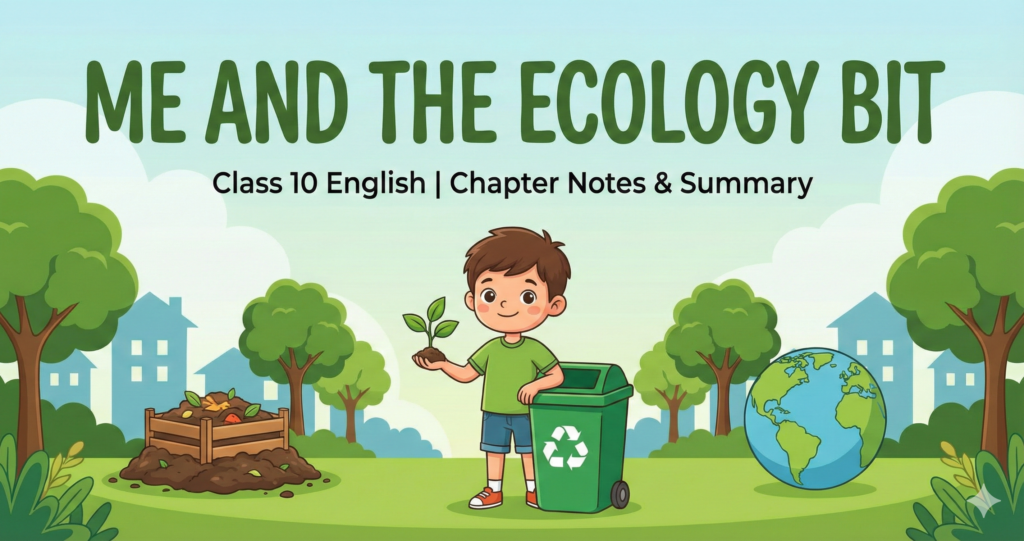
Me and the Ecology Bit
By Joan Lexau | Class 10 English
Chapter Summary: Joan Lexau’s present lesson brings out how the issue of preserving the environment and saving ecology is everybody’s concern but difficult to solve. Preaching about ecology is easy, but it is difficult to abide by the rules of ecology preservation.
Downloads
Free
Chapter Notes
Summary & Analysis
Premium
Solutions (Q&A)
Textbook Answers, Word Meaning, Line by Line Hindi & More Notes
Read Online
Joan Lexau’s present lesson ‘Me and the Ecology Bit’ brings out how the issue of preserving environment and saving ecology is every body’s concern and difficult to solve. Preaching about ecology is easy but it is difficult to abide by the rules of ecology preservation.
A. Look at the pictures given below and discuss the questions that follow:
- What are the slogans? Read out aloud.
- Why are these slogans displayed?
- Do you like these slogans? Why?
- Have you ever displayed such slogans or participated in any seminar on ecology preservation?
Sure it is hard to get people to work for ecology. Everybody is in favour of it but nobody wants to do anything about it. At least I’m doing something, going around telling people what they should do. But all I get is a lot of back talk.
I have this paper route. My father had one when he was a kid, so he made me get one last year. Between it and my homework, I hardly have time for playing ball and stuff, some days I get in only a few innings.
But anyhow, on Saturdays when I collect, I put in a good work for ecology. Like last Saturday morning. It was a good collecting day. It had just turned spring and a lot of people were outside.
I went to Mr. Williams’s house. As usual, he tried to pretend he’s not home. But I see him burning leaves in the backyard, so he’s stuck. He pays me, and I tell him. “You shouldn’t burn those leaves. It’s bad for air, bad ecology. You should make a compost pile like we do. Put in the leaves, garbage, and stuff. Good for the garden.”
He doesn’t agree or hang his head in shame. He says, “That compost pile is your job at home, Jim, isn’t it?”
“Yes,” I say proudly, which would shock the idea I hate working with compost. Which I do.
Mr. Williams says, “Well don’t you take a little more trouble with it, put enough dirt on top of each layer? Then we wouldn’t have this nose pollution.”
“Huh?” I say “You mean noise pollution.” “No,” he says. “I mean your compost smells up the whole street.”
B.1.1. Write T for True and F for False:
- 1. He uses paper route to convince the people.
- 2. People easily get convinced by Jim.
- 3. He gives suggestions on ecology free of cost.
- 4. Mr. Williams was at his house.
- 5. People listened to Jim gladly; for he was an eco-friendly boy.
My feelings are hurt, but that doesn’t stop me from trying again. I go to collect from Ms. Greene. I have to call her Ms. Greene because if I call her ‘Mrs’, she says she doesn’t have change to pay me.
She is putting her garbage out for the weekly pickup on Monday. She goes away on weekends; so on Saturdays and Sundays, we have to look at the big plastic garbage bags on her lawn. But I don’t say anything about it, I just look at the garbage.
She says to me, “Go pick up that gum wrapper you threw on my lawn. Put it in one of the plastic bags. Didn’t anybody teach you not to litter?”
I hold my temper and pick up my gum wrapper and put it in a bag. Then she says, And there’s a law in this town about keeping dogs on a leash. So, why is yours always all over the place? That dog digs up my garden and messes up my yard, and last weekend Mr. Williams saw it tear open one of my garbage bags.”
“Well,” I say, but I can’t think of anything to go with it. Then I see she is piling newspapers next to her garbage bags.
“Listen, Ms. Greene,” I say, “save those papers for the school pickup, and they can be made into new paper. Save aluminium cans, too.”
“Like the last school pickup?” she asks “When you said you’d come and pick them up, but you never showed up? It’s easier to throw them away a few at a time than have a big mess like that.”
I get tired of trying to get Ms. Greene to do something, about ecology. I go to Mr. Johnson’s house. He makes a run for his car, but I can run faster than he can.
B.2. Answer the following questions very briefly:
- What happens when the narrator calls Ms. Greene, ‘Mrs. Greene’?
- What does the narrator do on Saturdays and Sundays?
- Which animal messes up Ms. Greene’s yard?
- Why does the narrator ask Ms. Greene to save paper and aluminium cans?
- Did the narrator succeed in getting Ms. Greene do something about ecology?
“Just trying to get to the post office before it closes,” he says, huffing and puffing.
“You got time,” I say. “You even got time to walk. It’s only two blocks. You shouldn’t take your car when you don’t need to. The walk would be good exercise and save on gas. And not pollute. That’s ecology.”
“They sure are,” I say. “We had a lot about trees and ecology in school. They make the air better and stuff like that.”
“See that tree over there?” He says, pointing to where there isn’t any tree.
“I don’t see any tree,” I tell him.
“Of course not,” he says. “And no grass either. Because you made a path there taking a short cut from Mrs. Greene’s. There was a little tree just starting to get bigger there until you killed it by trying to jump over it everyday. Remember?”
“Oh,” I say.
“And talking about not driving when you can walk. You drive your motorbike round and round your backyard all summer. And your snowmobile all winter. Isn’t that wasting power and making noise pollution too?”
But it’s fun,” I say.
“Well, I enjoy taking the car to the post office,” he says, “But now you’ve made me too late.” He goes in the house looking very mad.
Then I remember he hasn’t paid me. But I decide to wait until next Saturday. At least I made him not pollute with his car for once.
I don’t talk to the rest of my route about ecology. It’s very boring work, this ecology bit.
But when I get home, I see my mother using the electric mixer.
“You should do that with your old egg beater,” I point out to her. “Save on electricity. Women use too many electric things.”
She says in a very cold voice, So who watches TV twenty-seven hours a day around here? Or is that some other kind of electricity?
See what I mean? Nobody’s willing to do anything about ecology, except me. And nobody listens to me.
B.3.1. Complete the following sentences:
- It is very … work, this ecology bit.
- Women use too many … things.
- Nobody’s willing to do anything about …
- The narrator drives his … round and round his backyard all summer and … all winter.
B.3.2. Answer the following questions very briefly:
- How many blocks away was the post office from Mr. Johnson’s house?
- What form of electricity did the narrator use?
- Why did Mr. Johnson think that the narrator did not follow the principle of walking?
- Did the narrator enjoy talking about ecology?
- ecology (n): the science that deals with the relationship between living things and the environment
- innings (n): turn of batting/bowling in cricket
- stuff (n): the material of which anything is made
- pretend (v.t): to profess falsely, to feign
- compost (n): manure
- garbage (n): filth
- pollution (n): state of environment being defiled or polluted or made filthy or dirty for various reasons
- wrapper (n): a loose paper cover
- keep dogs on a leash (verb phrase): keeping dogs tied
- mess (n): untidy state of things
- huffing and puffing (idm): breathing in a noisy way, panting
- ‘Nobody’s willing to do anything about ecology.’ Do you agree with the statement?
- “But anyhow, on Saturday when I collect, I put in a good work on ecology.” This is the narrator’s way of preserving ecology. How are you contributing to ecological preservation in your surroundings?
- ‘I get tired of trying to get Ms. Greene to do something about ecology.’ Explain in detail the meeting between Jim and Ms. Greene and throw light on the outcome of the meeting.
- ‘Sure it is hard to get people to work for ecology.’ Do you agree with this statement? What is ecology? What measures have you and your school taken to preserve it?
- “Women use too many electric things.” What prompts the narrator to say so? How does the use of modern appliances affect ecology?
- Do you think that Jim is a real ecology friendly boy? Give your opinion.
- Does Jim understand why his advice is being questioned? Explain.
- What happened to the tree referred to by Mr. Johnson?
- Is Jim aware of all of the aspects? Does he always practise ecology measures? Give arguments in favour of your answer.
- A hero or heroine does not always arrive on a galloping horse to save the day. Sometimes the hero or heroine merely demonstrates potential for action, rather than a completed task. What potential does Jim have as the hero in this story?
C.2. GROUP DISCUSSION
- 1. Environmental degradation leads to ecological imbalance.
- 2. Modern appliances adversely affect the environment.
C.3 COMPOSITION
- 1. Prepare a speech in about 100 words to be delivered in the morning assembly of the school on ‘how students can become ecology friendly’.
- 2. Write a letter to your friend, telling him the measures your school has taken to preserve ecology in the locality.
Ex. 1. Correct the spelling:
ekology, composte, garbedge, stufe, polusion, imings
Ex. 2. Match the words:
| Column A | Column B |
|---|---|
| compost | the science that deals with the relation between living things and environment |
| garbage | an act of polluting |
| pollution | to feign |
| pretend | filth |
| ecology | manure |
Example:
Active: He pays me and I tell him.
Passive: I am paid by him and he is told by me.
The verb in the passive voice is in the Past participle form (V3) and normally Preposition ‘by’ is used.
Ex.2 Change into Passive Voice:
- The children are playing the game.
- The teacher tells the story.
- The Minister is delivering the speech.
- The policeman catches thieves.
- The driver is driving the car.
- The children are playing the guitar.
- The postman has delivered the letters.
- The father scolded his son.
- The gardener has watered the flowers.
- The musicians are playing the band.
F. ACTIVITIES
- Do a project work on how to prepare compost.
- Find out what other fertilizers are being used for growing plants. Which of them are good for plants as well as human beings and which are bad. Then write a report on it.
G. TRANSLATION
Translate the following sentences into Hindi/Mother tongue.
- Sure it is hard to get people to work for ecology.
- He somehow has the idea that I hate working with compost.
- My feelings are hurt but that doesn’t stop me from trying again.
- She doesn’t have change to pay me.
- I get tired of trying to get Mrs. Greene to do something about ecology.
- Nobody’s willing to do anything about ecology.
- Nobody listens to me.
- It’s very boring work, this ecology bit.
Faq ( Me and the ecology)
छात्रों द्वारा अक्सर पूछे जाने वाले प्रश्न (FAQs):
Answer: “Me and the Ecology Bit” के लेखक Joan Lexau हैं।
Answer: इस कहानी में विडंबना यह है कि मुख्य पात्र जिम (Jim) दूसरों को पर्यावरण (Ecology) बचाने का उपदेश देता है, लेकिन वह खुद कागज और बिजली बर्बाद करता है और पेड़-पौधों को नुकसान पहुँचाता है।
Answer: जिम उन्हें ‘Mrs. Greene’ इसलिए नहीं बुलाता क्योंकि ऐसा कहने पर वे बहाना बनाती हैं कि उनके पास उसे देने के लिए छुट्टे पैसे (Change) नहीं हैं।
Answer: जिम Mr. Williams को सलाह देता है कि वे पत्तियों को न जलाएं क्योंकि इससे वायु प्रदूषण होता है। उसे पत्तियों और कचरे से खाद (Compost) बनानी चाहिए।
Answer: Mr. Johnson कार से इसलिए जाते हैं क्योंकि पोस्ट ऑफिस बंद होने वाला था और जिम के साथ बहस करने में उन्हें देर हो गई थी।
Answer: जिम की माँ व्यंग्य (taunt) करती हैं कि घर में कौन 27 घंटे टीवी देखता है? उनका इशारा जिम की तरफ होता है जो खुद बिजली बर्बाद करता है।
Answer: जिम शॉर्टकट लेने के चक्कर में उस छोटे पेड़ के ऊपर से कूदता था, जिससे वह पेड़ मर गया (नष्ट हो गया)।
Answer: नहीं, जिम खुद नियमों का पालन नहीं करता। वह अपनी माँ, Mr. Johnson और Ms. Greene को सलाह देता है, लेकिन खुद मोटरबाइक चलाकर और पेड़ नष्ट करके प्रदूषण फैलाता है।
Answer: यह कहानी दिखाती है कि पर्यावरण संरक्षण (Ecology preservation) के बारे में बात करना आसान है, लेकिन उस पर अमल करना मुश्किल है। हर कोई चाहता है कि दूसरे काम करें, पर खुद कोई जिम्मेदारी नहीं लेना चाहता।
Answer: आप इस पेज के ऊपर दिए गए “Downloads” सेक्शन में लाल रंग के “Premium” बटन पर क्लिक करके सभी प्रश्न-उत्तर, शब्दार्थ और हिंदी नोट्स डाउनलोड कर सकते हैं। विजिट करें: Englishvidya.com/notes